Fueling Freedom Amid Trade Wars: Fast-Tracking Ethanol and Green Hydrogen to Counter Trump’s Tariffs
Strengthening energy sovereignty through home-grown ethanol and green hydrogen
Last Updated:
August 2, 2025
Synopsis
Facing tariffs on exports and sanctions on oil imports, India must rapidly scale domestic alternative fuels to protect its economy. Early success with twenty percent ethanol blending and emerging green hydrogen clusters prove viable pathways, yet capacity gaps, feedstock constraints, slow flex fuel adoption, and regulatory bottlenecks impede progress. A single window legal framework, clear safety standards, and strong incentives can synchronise innovation and investment, trimming import bills, boosting rural incomes, decarbonising industry, and enhancing energy sovereignty for future stability.
Introduction
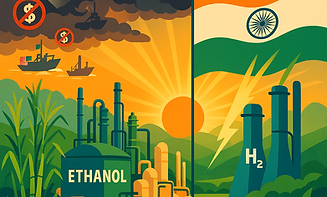
President Donald Trump’s decision to impose a twenty-five percent tariff on all Indian exports from 1 August 2025, together with warnings that future “penalties” could target Russian-linked crude imports, has exposed two vulnerabilities: India’s heavy reliance on external markets and an annual oil import bill exceeding ninety billion dollars. Developing domestic alternative fuels, especially ethanol and green hydrogen, is no longer merely a climate objective; it has become a strategic buffer against this new trade pressure.
Trump-era trade shockwave
The tariffs hit labour-intensive exports such as engineering goods, electronics and textiles, but the broader signal is unmistakable. If future negotiations link energy sanctions to trade concessions, every imported barrel of crude and every shipload of liquefied natural gas becomes a bargaining chip. A diversified, home-grown fuel mix would reduce dollar demand, moderate pump-price volatility and give policymakers greater leverage at the negotiating table.
Ethanol: a ready springboard
India reached its national target of twenty percent ethanol-in-petrol blending in 2025, five years ahead of schedule, by expanding production from 3.8 billion to more than sixty-six billion litres within a decade. This rapid scale-up already saves roughly forty-one thousand crore rupees in foreign exchange each year. Second-generation projects, such as the bamboo-based biorefinery at Numaligarh, demonstrate how non-food feedstocks can uplift rural incomes without stressing cereal supplies.
Yet growth still leans on first-generation sugarcane and surplus rice. The Food Corporation of India recently earmarked more than five million tonnes of grain for fuel, underscoring the need to accelerate crop-residue collection, ligno-cellulosic technologies and nationwide flex-fuel vehicle deployment so food security remains intact.
Hydrogen: securing tomorrow’s molecule
The National Green Hydrogen Mission envisions up to eight lakh crore rupees in investment and positions India as a global production hub. With a unified national grid and rapidly expanding renewables, India aims to produce the world’s most affordable green hydrogen. Progress on the ground is visible: a fully indigenous one-megawatt electrolyser came online at Kandla port in four months, and larger clusters are advancing from Pune to Jodhpur with fresh federal support.
Where India is falling behind
Capacity gap
Domestic electrolyser manufacturing trails far behind global leaders, keeping costs high and limiting project pipelines.
Ethanol feedstock pinch
Current capacity of about sixteen billion litres is only just sufficient to sustain E20 blending at scale.
Slow flex-fuel adoption
Unlike Brazil, India has only a nascent fleet of flex-fuel vehicles and limited E 85 dispensing infrastructure, capping ethanol demand growth.
Legal and innovation hurdles
Hydrogen storage codes, high-blend ethanol standards and environmental clearances move through multiple ministries, stretching timelines and deterring start-ups. A single-window clearance model and clearer fiscal incentives are essential for speed.
Why law and innovation must accelerate
Policy ambition alone cannot deliver scale. The legislative framework needs streamlined approval processes, enforceable safety standards, and technology-neutral carbon-reduction credits that reward genuine innovation. Concurrently, industry must invest in research, pilot projects and skills development to bridge technology gaps. Fast-tracking both lawmaking and innovation will synchronise capital flows, de-risk private investment and shorten the path from lab to market.
Strategic benefits of alternative fuels
A deeper ethanol pool could trim the oil import bill by more than forty-one thousand crore rupees annually while boosting rural earnings from agri-residue. Green hydrogen can curb fertiliser and refinery dependence on grey hydrogen, slash industrial carbon emissions by up to forty-five percent and open export avenues in clean ammonia and methanol. Together, these fuels strengthen energy sovereignty, create skilled jobs and enhance India’s resilience in future trade disputes.
Policy steps to accelerate progress
Mandate nationwide E20 by April 2026 and establish an E 85 corridor on national highways to ensure market certainty for flex-fuel vehicles.
Launch a ten-thousand-crore viability-gap fund for second-generation ethanol plants using bamboo, bagasse and crop stubble.
Publish a technology-neutral clean-fuel standard that values lifecycle carbon reductions equally for ethanol, hydrogen and other alternatives.
Fast-track the Hydrogen Infrastructure Safety Bill so pipelines, cylinders and port bunkering terminals receive approvals by 2027.
Link production-linked incentives and export-credit support to clean-tech localisation, scaling electrolyser, fuel-cell and flex-fuel component manufacturing.
Conclusion
Trade friction with the United States highlights how swiftly external shocks can disrupt India’s growth trajectory. Ethanol and green hydrogen offer credible shields by cutting oil imports, stabilising rural incomes and opening new export opportunities in clean molecules. A unified legal framework, sharper fiscal incentives and a rapid culture of industrial innovation must converge if India is to convert this moment of geopolitical challenge into long-term energy security and economic resilience.